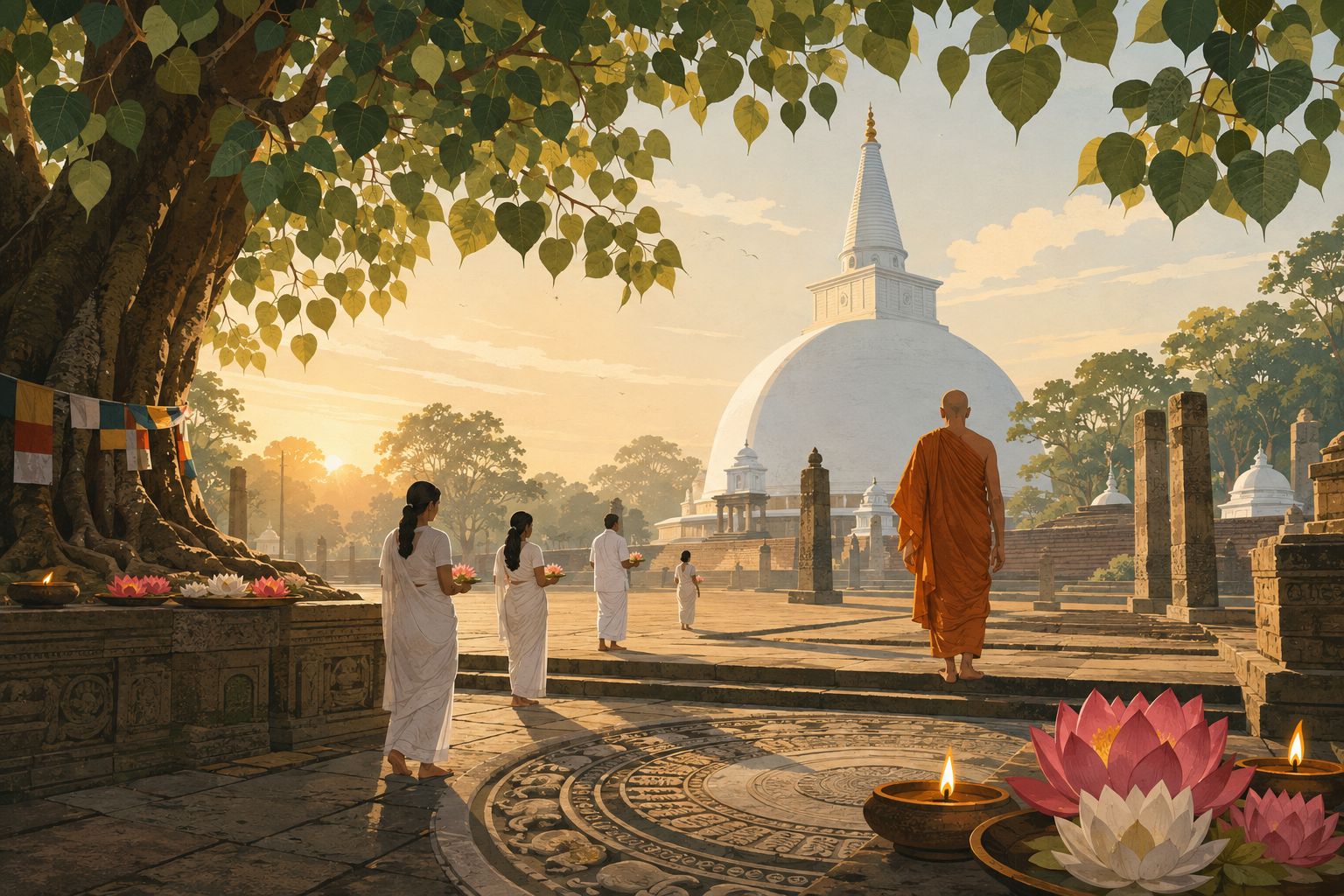
Buddhism has influenced Sri Lanka for more than two millennia. Its stupas, monasteries and sacred trees form one of Asia’s great cultural landscapes, yet the tradition becomes most meaningful when travellers notice the living practices around them: flowers offered at dusk, lamps lit with care and families gathering on a full-moon day.
Begin with a living tradition, not a museum label
Most Sri Lankan Buddhists follow the Theravada tradition. Temples serve as places of worship, teaching, community gathering and memory. Ancient sites such as Anuradhapura remain filled with pilgrims as well as visitors.
Buddhism is central to Sinhala culture, but Sri Lanka is religiously diverse. Hindu, Muslim and Christian communities also shape its history and present. Understanding the country means respecting all of these traditions.
How Buddhism took root in Sri Lanka
Sri Lankan tradition connects Buddhism’s arrival in the third century BCE with Mahinda, a monk and son of the Mauryan emperor Ashoka, during King Devanampiya Tissa’s reign. Mihintale is associated with their meeting.
Sanghamitta, Mahinda’s sister and a Buddhist nun, is traditionally said to have brought a sapling from the sacred Bodhi tree at Bodh Gaya. The Sri Maha Bodhi at Anuradhapura remains one of the island’s most revered places.
Theravada Buddhism in simple terms
Theravada means “Teaching of the Elders.” It draws on the Pali Canon and emphasises understanding suffering, ethical conduct, mental cultivation and wisdom. The Four Noble Truths and Noble Eightfold Path sit at the heart of Buddhist teaching.
For visitors, generosity may be the most visible principle. People offer food to monks, flowers at shrines and support to temples. Buddhist life is also expressed through ordinary acts of patience, care and giving.
Four places that reveal different chapters
Anuradhapura brings together the Sri Maha Bodhi, monumental stupas and active pilgrimage. UNESCO describes it as a sacred city established around a cutting from the Buddha’s fig tree and a major political and religious centre for roughly 1,300 years.
Mihintale is associated with Buddhism’s arrival. Dambulla preserves a remarkable cave-temple complex. In Kandy, the Temple of the Sacred Tooth Relic sits within a royal and religious landscape recognised by UNESCO.
Flowers, lamps and the rhythm of Poya
Lotus and jasmine offerings honour impermanence. Oil lamps symbolise light and understanding, while incense creates a contemplative atmosphere. These are devotional acts, not decorations for a photograph.
Every full moon is a Poya public holiday. Vesak commemorates the Buddha’s birth, enlightenment and passing away. Poson remembers the introduction of Buddhism to Sri Lanka and is especially significant around Mihintale.
Temple etiquette every traveller should know
Cover shoulders and knees, remove shoes and hats where required, speak softly and follow local signs. Never pose with your back to a Buddha image or climb, sit on or touch sacred structures.
Walk clockwise around stupas when joining worshippers. Ask before photographing monks or ceremonies, and put the camera away when it would disturb prayer.
Travel with curiosity, not certainty
A good guide can explain symbolism and history without turning a living religion into spectacle. Ask sincere questions, avoid interrupting rituals and make donations through clearly marked official channels.
Give sacred cities enough time. Anuradhapura is more rewarding over a full day or two than as a rushed stop. Dawn and evening bring cooler air and reveal the devotional rhythm beyond busy sightseeing hours.
Look at the monument.
Notice the living meaning.
When travellers move quietly, dress respectfully and understand that worship continues around them, Sri Lanka’s sacred places reveal far more than architecture.
UNESCO: Sacred City of Anuradhapura ↗
UNESCO: Sacred City of Kandy ↗