Sri Lanka through time

A first guide · Six defining eras

An island
of stories.

From ancient capitals and ocean trade to colonial rule and a modern republic — begin with the big picture, then go deeper.

Explore the timeline
Illustration of Anuradhapura's great stupa, sacred Bodhi tree and ancient moonstone
Ancient capitalc. 4th century BCE–11th century CE
The big picture

One island.
Many centres of power.

Sri Lanka’s past is not a straight line of kings. It is a layered story of migration, faith, trade, engineering, competing kingdoms and encounters across the Indian Ocean.

01

Origins & exchange

Early communities developed across the island while seaborne trade connected Sri Lanka to South India and the wider Indian Ocean.

Archaeology, inscriptions and later chronicles do not always tell the same story; legendary traditions are best read alongside physical evidence.
02

Anuradhapura

A long-lived capital grew into a major Buddhist centre, supported by monumental stupas and a remarkable network of reservoirs and canals.

The sacred city remains a living place of pilgrimage, not only an archaeological site.Read the Anuradhapura chapter ↓
03

Polonnaruwa

After Anuradhapura’s decline, Polonnaruwa became the royal centre. Vijayabahu I restored local rule and Parakramabahu I oversaw an ambitious age of building and irrigation.

Its ruins reveal both South Indian influence and a renewed Sinhala Buddhist kingship.
04

Many kingdoms

Power moved among Dambadeniya, Yapahuwa, Kurunegala, Gampola and Kotte, while the Jaffna kingdom was a major Tamil centre in the north.

There was no single, unchanging capital: the island’s story belongs to several regions and communities.
05

Coasts, Kandy & empire

The Portuguese and Dutch controlled much of the coast. The Kandyan kingdom endured inland until the British took sovereignty in 1815 and unified the island under colonial rule.

Plantation agriculture, railways, migration and resistance transformed the economy and society.
06

Independence & republic

Ceylon became independent in 1948 and the Republic of Sri Lanka in 1972. The modern story includes democratic change, social progress, civil conflict and continuing reconciliation.

Present-day Sri Lanka is shaped by Sinhala, Tamil, Muslim, Burgher and other communities.
Deep chapter 01

Anuradhapura

The city that
shaped an island.

For more than a millennium, Anuradhapura was the political and spiritual heart of Sri Lanka. Kings ruled here, monks studied here, and engineers turned a dry landscape into a fertile civilisation through a brilliant network of reservoirs and canals.

A city across centuries

From royal capital
to living heritage.

01

A capital takes shape

Tradition credits King Pandukabhaya with establishing and carefully planning Anuradhapura as a royal capital.

02

Buddhism transforms the city

Buddhism takes root during the reign of Devanampiya Tissa. A sapling of the sacred Bodhi tree arrives from India with Sanghamitta Theri.

03

Monuments rise

Rulers build enormous stupas, monasteries and reservoirs—turning the capital into one of the great cities of ancient South Asia.

04

A global centre of learning

Vast monastic communities such as Abhayagiri connect Sri Lanka with Buddhist worlds across India and Asia.

05

The capital moves

After centuries of conflict and political change, the royal centre shifts to Polonnaruwa, while Anuradhapura remains sacred.

06

A living sacred city

Pilgrims still worship here. Archaeology, ritual and everyday life continue side by side across the UNESCO-listed city.

The royal story

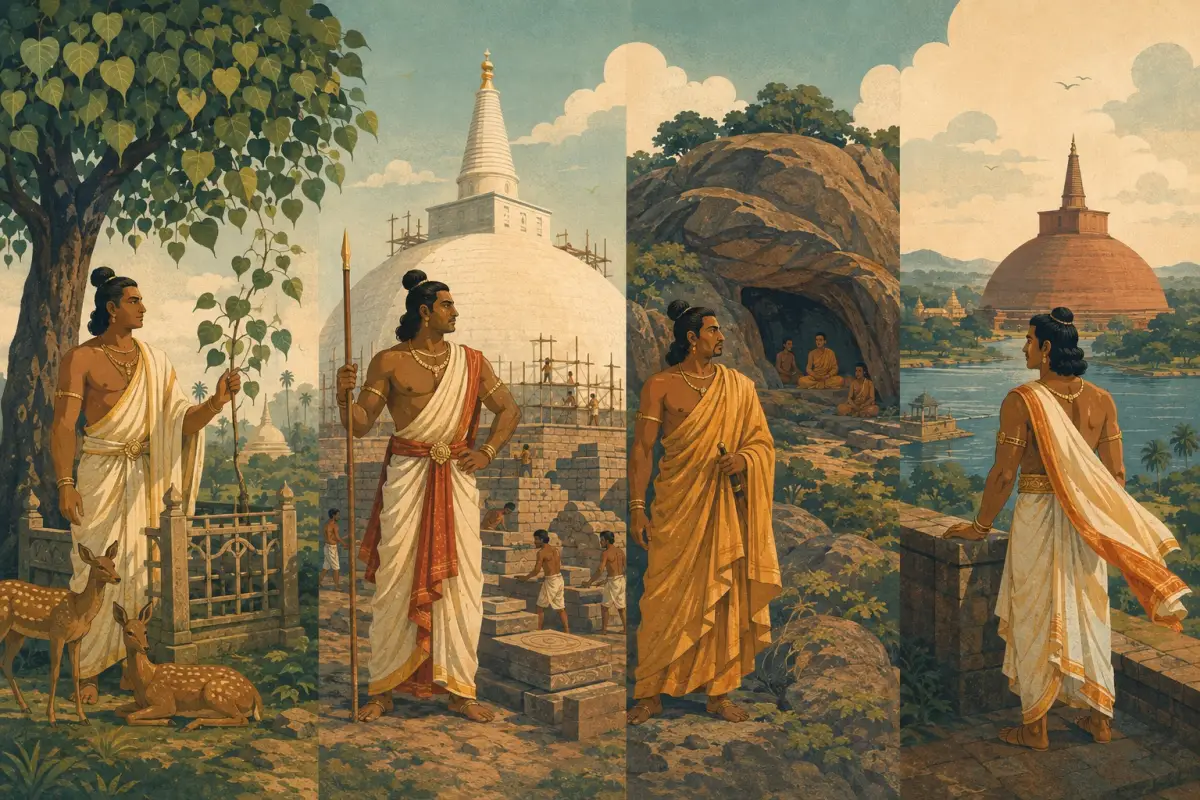
Kings who shaped
Anuradhapura.

Across thirteen centuries, rulers built, defended and repeatedly remade the capital. Their stories come from inscriptions, archaeology and later chronicles such as the Mahavamsa.

Artist's interpretation of influential Anuradhapura kings with the sacred Bodhi tree, great stupas, a monastery and reservoir
Artist’s interpretationSymbolic scenes inspired by the rulers’ legacies; no contemporary portrait likenesses are known.
01
Traditional date · 4th century BCE

Pandukabhaya

The city builder

Sri Lanka’s chronicles credit Pandukabhaya with establishing Anuradhapura as a planned royal capital, organising settlements and shaping the city that later rulers would transform.

02
c. 247–207 BCE

Devanampiya Tissa

The Buddhist king

During his reign, Buddhism took root through the mission associated with Mahinda. Sanghamitta Theri later brought the sacred Bodhi-tree sapling around which the holy city grew.

03
c. 161–137 BCE

Dutugemunu

The monumental patron

Remembered in the chronicles for unifying the island after defeating King Elara, he commissioned major monuments including Mirisavetiya and Ruwanwelisaya.

04
c. 1st century BCE

Valagamba

The returned king

After losing and later regaining the throne, Valagamba became closely associated with Abhayagiri monastery—an institution that would connect Anuradhapura to Buddhist worlds across Asia.

05
c. 3rd–4th century CE

Mahasena

The reservoir king

Mahasena’s reign combined religious conflict with ambitious building. He is remembered for Jetavanaramaya and major irrigation works, especially the great Minneriya reservoir.

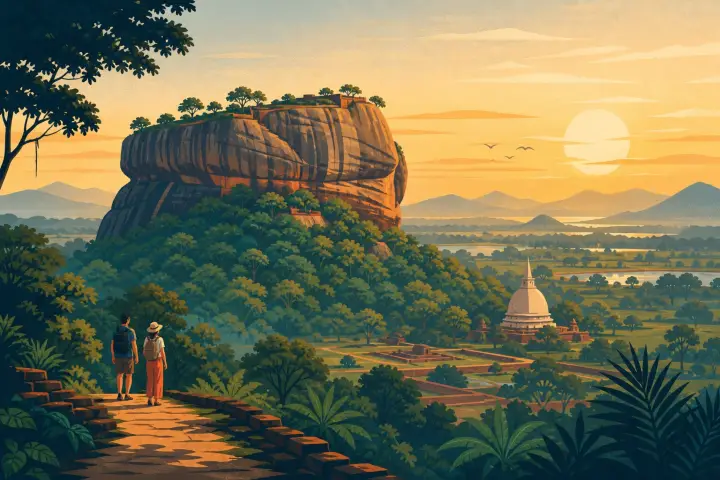
Illustrated landscape of Sri Lanka's Cultural Triangle
Genius in water

A civilisation
built to flow.

Anuradhapura flourished in Sri Lanka’s dry zone because its engineers captured seasonal rain. Great reservoirs—known locally as wewa—fed canals, rice fields, monasteries and communities.

“Not even a little water that comes from the rain must flow into the ocean without being made useful.”Traditional maxim associated with Sri Lankan hydraulic civilisation
The sacred city

Six places that tell
the story.

01

Sri Maha Bodhi

A sacred fig tree traditionally grown from a southern branch of the tree under which the Buddha attained enlightenment.

02

Ruwanwelisaya

The great white stupa commissioned by King Dutugemunu remains one of Sri Lanka’s most revered monuments.

03

Jetavanaramaya

Its immense brick stupa was among the tallest structures of the ancient world and anchored a major monastery.

04

Abhayagiri

A far-reaching monastic complex that welcomed diverse traditions and connected the island to wider Asian networks.

05

Thuparamaya

Traditionally regarded as the island’s earliest stupa after the introduction of Buddhism.

06

Kuttam Pokuna

The elegant ‘Twin Ponds’ reveal the sophistication of ancient water engineering and monastic design.

Visit with respect

History is still
alive here.

Anuradhapura is both a heritage site and a place of worship. Move slowly and follow local cues.

  • 01Cover shoulders and kneesLight, modest clothing works best in the heat.
  • 02Remove shoes and hatsDo so before entering sacred terraces and temple areas.
  • 03Never pose with your back to a Buddha imageKeep photographs quiet and respectful.
  • 04Start earlyDawn offers cooler air, gentle light and an unhurried atmosphere.
Continue exploring

See where the
story lives.

Explore Sri Lanka