Ravana belongs first to the world of epic literature. Yet across South Asia—and especially in modern Sri Lanka—his story has gathered local landscapes, new meanings and passionate retellings.
The story in brief
In the Ramayana, Ravana is the formidable ruler of Lanka. He abducts Sita, the wife of Rama, and carries her to his island kingdom. Rama travels south with Lakshmana and an army of vanaras, crosses the sea, defeats Ravana and rescues Sita. This central conflict has been retold for centuries in poetry, ritual, dance, theatre, television and oral storytelling.
There is no single Ramayana. Sanskrit, Tamil and many regional versions differ in tone and detail, and communities often understand the characters through their own religious and cultural traditions.
A more complex Ravana
Ravana is frequently described as a ten-headed rakshasa king and the epic’s antagonist. The ten heads are interpreted in many ways: as literal power in the story, as vast knowledge, or as uncontrolled passions. Later traditions also remember him as learned, musically gifted and devoted to Shiva.
That complexity explains his lasting fascination. He can represent arrogance and destructive desire, but also intelligence, kingship and resistance. Modern writers and performers sometimes retell the epic from his point of view, asking who is allowed to be called hero or villain.
Legend is not the same as history
The epic calls Ravana’s kingdom Lanka, but identifying that literary island directly with the modern nation of Sri Lanka is a matter of tradition and interpretation. Scholars study when and how the Ramayana circulated on the island; they do not treat every named landscape as archaeological confirmation.
Sri Lanka’s documented ancient history is reconstructed from excavated material, inscriptions, coins, architecture and chronicles read critically together. Ravana does not appear in that evidence as a verified monarch with secure dates, buildings or a documented dynasty.
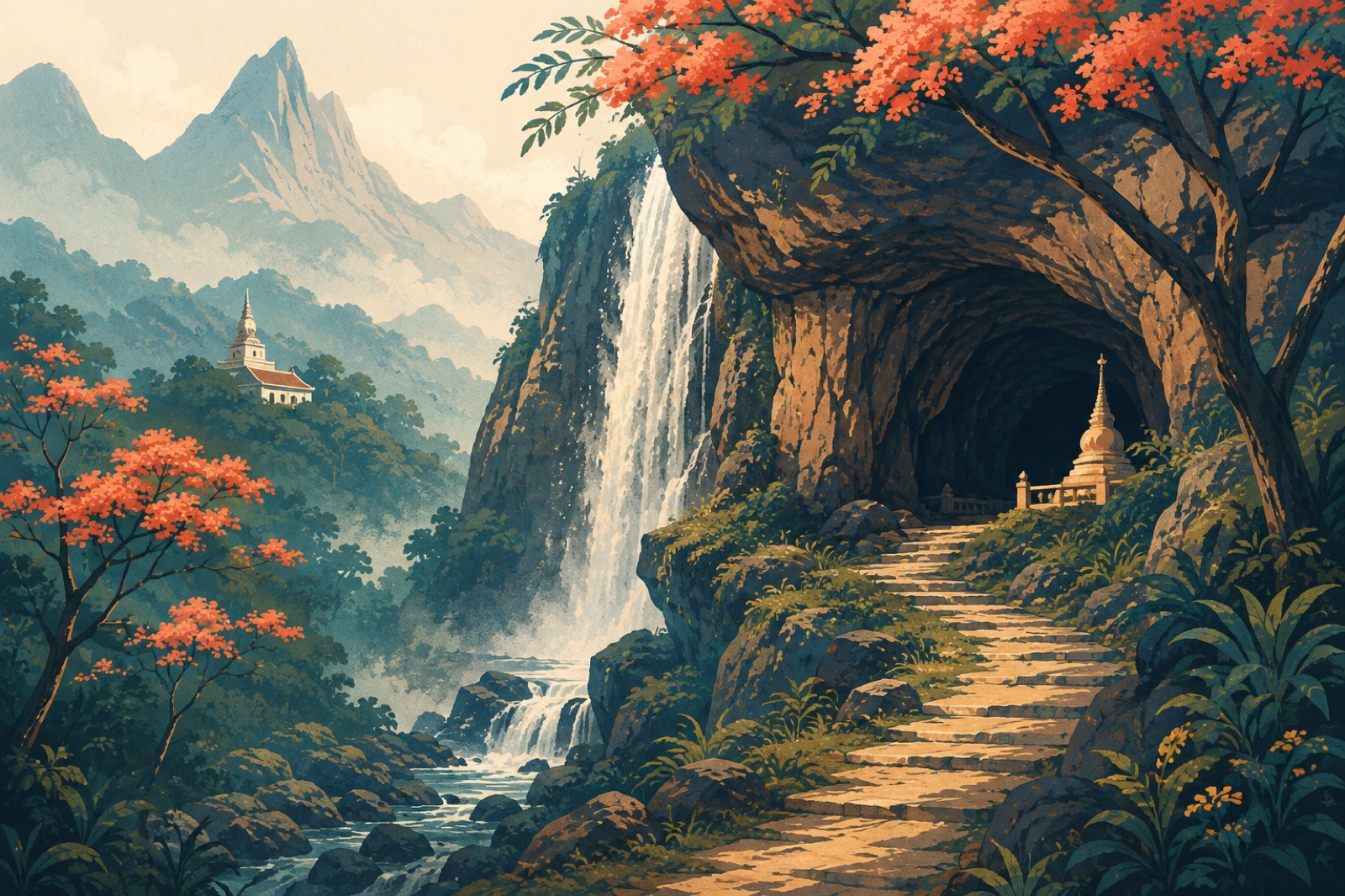 Artistic interpretation of landscapes associated with living Ramayana traditions.
How Ravana became Sri Lankan
Ramayana stories have circulated among Sri Lankan Hindu and Buddhist communities for centuries, but Ravana’s especially strong image as an ancestral Sri Lankan king is also a modern cultural development. Contemporary books, television, tourism and online communities have expanded that image.
Some Sri Lankan retellings portray him sympathetically—as a capable ruler, healer or scholar rather than a simple villain. These interpretations matter as living culture even when their claims cannot be verified as ancient history.
Places connected by tradition
Today a “Ramayana Trail” links temples and landscapes that devotees or local stories associate with the epic. Frequently mentioned places include Seetha Amman Temple near Nuwara Eliya, Ravana Falls and Ravana Cave near Ella, Divurumpola, Ussangoda and the chain of limestone shoals known as Adam’s Bridge or Rama Setu.
These are real and often beautiful places. Their connection to particular epic events is devotional or folkloric rather than archaeological proof. Visitors can appreciate both the landscape and the belief without confusing one for the other.
How to explore respectfully
Approach Ramayana-linked places as living religious and cultural spaces. Dress modestly at temples, ask before photographing worshippers and listen to how local guides describe a site. Good guides should make clear whether a statement comes from scripture, folklore, local memory or physical evidence.